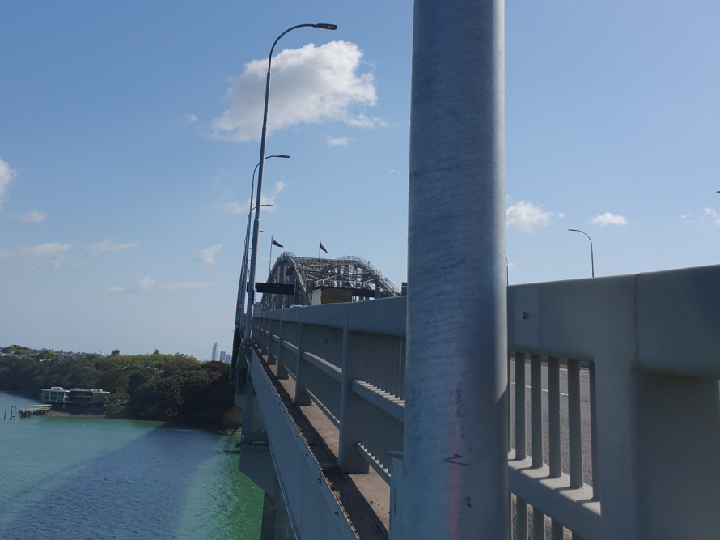
Auckland Harbour Bridge
Auckland Harbour Bridge
January 1, 2019
“When dealing with unsealed steel hollow sections, hot-dip galvanizing is the only way to protect the poles. Galvanizing delivered longevity and was the most cost-effective choice.”
- LocationAuckland, New Zealand
- Year Galvanized2019
- Components GalvanizedSteel pole sections, lids, and doors
- OwnerNZ Transport Agency
- OrganizerAuckland Harbour Bridge Alliance
- Construction ManagerTotal Bridge Solutions
- EngineerWSP
- FabricatorRivet - Fabrication by Design (New Plymouth)
- Galvanizer
A Bridge Built to Last
The Auckland Harbour Bridge has been one of the most iconic and busiest bridge structures in New Zealand. It not only connects water, telecommunication, power and gas services; but also carries an average of 180,000 vehicles that travel over the bridge each day. This makes it one of the country’s most vital infrastructure links not only between the North Shore suburbs and the rest of Auckland City, but between the Northland Region and the rest of New Zealand.
WSP led the way in the lighting design and replacement of more than 140 High Pressure Sodium (HPS) lamps with low energy LEDs. The use of LEDs has had an immediate impact, lowering maintenance and operational costs, and significantly reducing light pollution from the bridge. The new lights improve nighttime visibility for drivers and for a safer driving experience.
New hot-dip galvanized poles were designed to withstand the applied loadings and vibrations, while still combining the aesthetics of the original poles. This ensured a visual continuation between the past and the future, while providing a low-maintenance solution for the next 50 years. By hot-dip galvanizing and bolting the poles onto a new welded flanged base connection onto the existing pedestals, our team was able to quickly remove a pole and replace it with a refurbished pole overnight. Galvanizing delivered longevity and was the most cost-effective choice.
Although the selection of steel allowed the artist to incorporate unique and meaningful features, the team had to consider how to protect the final sculpture from the corrosive atmosphere. The salty sea air surrounding New Zealand can wreak havoc on steel that hasn’t been protected. Unsightly rust would be unacceptable on an important sculpture of this stature and it would not pay homage to the ‘Atua’ (God) it was named after. A local, highly reputable galvanizer taught the project team about the protective qualities of hot-dip galvanizing years ago when constructing the Whatonga sculpture and they determined it would be the best option for this sculpture as well. Longevity was the most sought after benefit; however, they also desired aesthetic look of silvered steel.
Hot-dip galvanizing offered a solution to corrosion control that enabled the project team to use a medium that could bring their vision to life. Communication between the artist, fabricator and galvanizer was important to ensure drain and vent holes were incorporated in to the design. All team members knew exactly how the item was going to be dipped before it even arrived at the galvanizer’s facility. Careful attention to the suspension of the sculpture during galvanizing was necessary to ensure all parts could be coated without creating air pockets or zinc traps. The extra effort was evident in the resulting finish quality. Hot-dip galvanizing will give lasting weather resistance to the sculpture for future generation to enjoy, and it will help the sculpture remain contemporary into the future.